From a finished Figma file to a production Next.js front-end.
Your studio keeps the design. I turn it into code: the typography you set, the motion you specified, and a site that still feels fast on a mid range Android. Built for designs a site builder cannot carry.
What the build covers
Three stages, one agreed price. The review happens before we sign anything, so the scope is based on your actual file and not on a guess.
Design file review
I go through pages, components and variants, auto layout, text and colour styles, fonts and their licences, exported assets, prototype interactions, and every state the file leaves undecided for tablet and mobile. You get that list of open questions before we agree on scope, not halfway through the build.
Production front end
Next.js and Tailwind, components that follow the structure of your design system, fluid breakpoints instead of three fixed widths, images served in modern formats at the sizes actually used, and motion built on GSAP so it runs on the GPU and degrades on weaker devices instead of stuttering.
Launch checks
Lighthouse on performance, accessibility and SEO. Keyboard navigation and visible focus, a reduced motion fallback, metadata and link previews, redirects, analytics consent, and a pass on a real mid range phone rather than a desktop browser window resized to look like one.
Fixed scope pricing
A Figma to Next.js build starts at €2,500 after the file review. The final figure depends on page count, how much motion the design carries, CMS needs, integrations and whether the content is ready. You get one price for an agreed scope, not an hourly rate.
Hand built, and only where that is the right answer
A builder is often the better buy. It is worth knowing which side of the line your project sits on before anyone quotes you.
When a site builder is enough
Webflow, Framer or a good template are the right call for a marketing site with conventional sections, a simple CMS and no unusual motion. That is most projects. If yours is one of them, I will tell you so and you will save money.
When code is the only way
Custom scroll choreography, 3D in the page, a design system with real component logic, a strict performance budget, user accounts, an API or a backend behind the site, and anything your client will later want to grow into an application. These are the projects where a builder starts costing more than it saves.
Built from someone else's design
A public project where the design came from outside and I delivered the build. Every claim below is measurable on the public URL.
vondrart.studio
A brand studio delivered the visuals and a precise idea of how the site should move. I delivered the code, the animation and the optimisation, without losing a frame of the intent and without dropping it on a weaker phone.
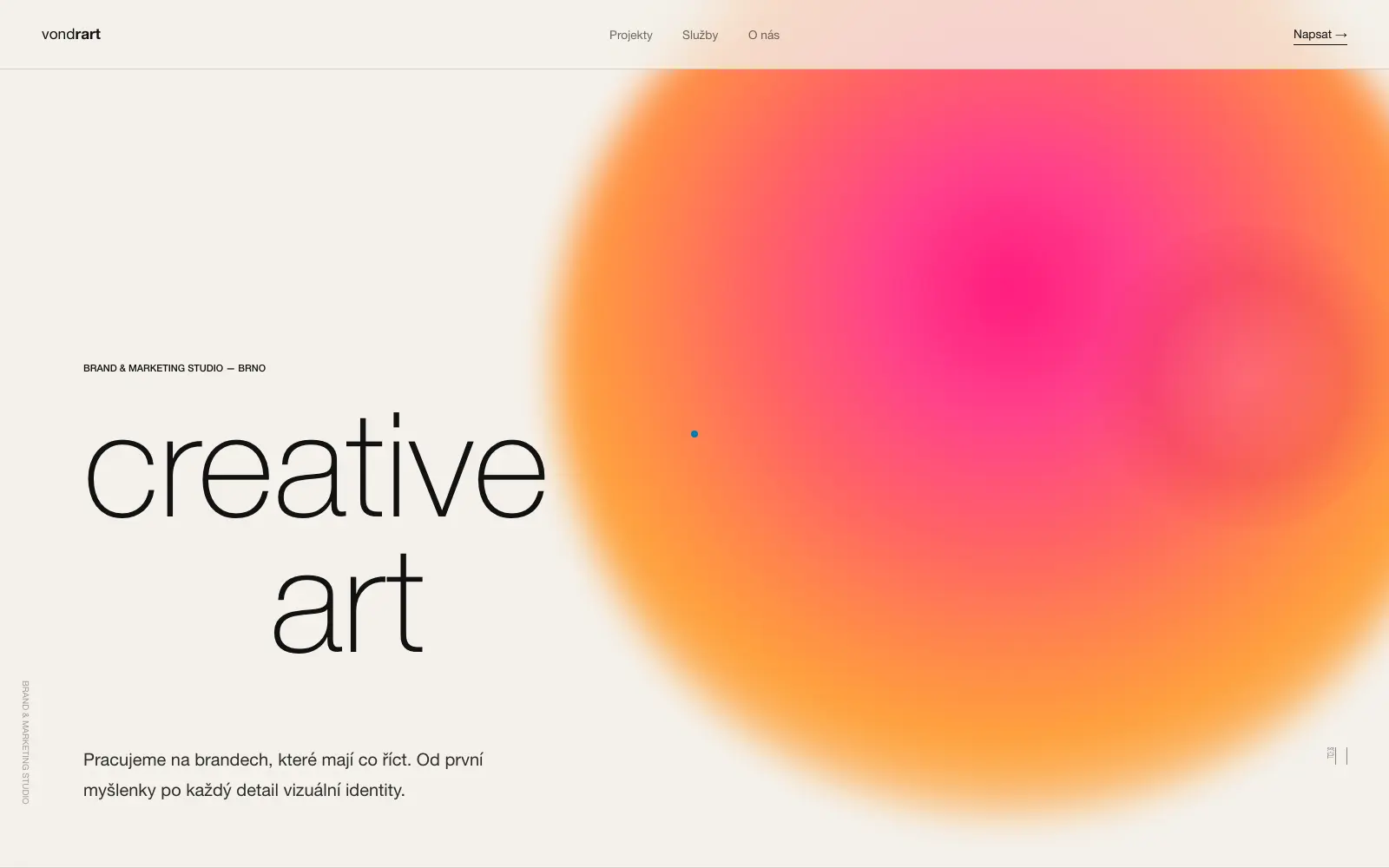
Design credit stays with the designer. I built the front end. There are more under NDA that I cannot show, and I would rather name one I can prove than pad the list.
What the build can carry
This one I designed as well, so it is not a design-handover reference. It is here because it is the clearest public measure of the technical bar I work to.
syndikat.studio
A signature 3D object and scroll storytelling. Lighthouse 100 on accessibility and SEO, and the whole site including the 3D scene under half a megabyte of transfer. Heavy scenes never download to weaker phones at all.
Live siteHow it works
Three working days from your file to a scope and a number.
Send the file
Figma, Sketch or XD, plus which pages you consider final. Within three working days you get the open questions, the scope and one price.
Build on a preview URL
The site goes up section by section on a link you can open at any time. You comment in Figma or on the preview. No three week silence followed by a reveal.
Launch and handoff
Deployment, the launch checks above, and a repository your own developer can pick up: readable components, standard tooling, no framework of my own invention.
What you actually receive
The repository
Full source on your Git organisation or mine transferred to you, with a readme covering local setup, environment variables and deployment.
The ownership
The code is yours on final payment. No licence, no hosting lock in, no dependency on me to publish a change.
After launch
Fourteen days for anything that turns out broken, at no cost. Beyond that, either a small retainer or you never hear from me again, whichever you prefer.
Figma to Next.js, answered
How do you convert a Figma design to Next.js?
Not automatically. I read the file first: components, variants, styles, responsive states and what the design leaves open. Then the design is rebuilt as Next.js components that follow the structure of your design system, with real breakpoints, optimised assets and motion built to run on the GPU. Plugins that export Figma to code produce markup nobody can maintain a month later.
Do you work as a subcontractor for design studios?
That is most of this work. The studio keeps the client relationship, the design credit and the invoice to their client. I appear as your developer or not at all, whichever you sell better. I have signed NDAs on this basis and I do not publish work you have not cleared.
How exactly will it match the design?
Pixel accurate at the breakpoints in your file, and reasoned where the file is silent. Every design leaves gaps between the artboards, so I list those gaps in the review and you decide them rather than discovering my guess at launch.
Why not just use Webflow or Framer?
For a standard marketing site you should. I build in code when the design needs custom scroll choreography, 3D, a strict performance budget, real component logic, user accounts or a backend, which is where a builder starts costing more than it saves. If your project fits a builder, I will say so.
What do you need from us to start?
The design file with the pages you consider final, the fonts and their licences, any brand or motion guidelines, and the content or a clear note that it is coming later. Missing content is fine, missing decisions about mobile are what delay projects.
Where are you based and how do we work together?
Czechia, in Central European Time, which overlaps the full working day in Germany, Austria and Switzerland. Everything runs over email, a shared preview link and a call when a call is genuinely faster.
Send a design file.
Attach the Figma link or the file. Within three working days you get the open questions, the scope and one price.